


In today’s digital landscape, telehealth has rapidly become a cornerstone of healthcare delivery, connecting patients and providers without the barriers of distance. While virtual consultations offer unmatched convenience and accessibility, reaching the right audience remains a challenge. That’s where local SEO for telehealth comes into play. By refining your online presence to target specific communities, you can attract patients who are actively searching for services in their area. This approach not only drives more qualified traffic but also fosters trust and loyalty among local populations ready to engage with virtual care.
Throughout this comprehensive post, you’ll explore proven strategies to enhance your visibility in local searches—from understanding audience behavior and conducting targeted keyword research to on-page optimization and reputation management. We’ll also dive into citation building, backlink tactics, and advanced methods to maintain a competitive edge. Along the way, you’ll find links to authoritative resources such as the Centers for Disease Control and Prevention (https://www.cdc.gov) and the National Institutes of Health (https://www.nih.gov) to ground your efforts in best practices. Whether you’re launching a new telehealth practice or looking to expand patient acquisition this year (2026), these insights will provide a clear roadmap to sustainable online growth.
The Critical Role of Local SEO for Telehealth Practices
Local SEO for telehealth focuses on optimizing your website and digital assets so that patients in your service area can find you when searching for virtual care. Unlike broad, nationwide campaigns that face high competition for generic terms, local strategies narrow your reach to users with higher intent. When someone types “telehealth mental health services near me” or “virtual primary care in Seattle,” you want your practice to appear at the top of search results and within map packs.
Focusing on local SEO has several benefits. First, it reduces competition by concentrating on your immediate market. Patients who prioritize convenience and timeliness are more likely to convert into new appointments. Second, it builds credibility. High-ranking local listings signal reliability and community relevance, essential factors in healthcare decision-making. Third, it fosters repeat business. Patients who discover your practice through local search are more inclined to return for follow-up visits because they feel a connection to a provider operating within their region.
Integrating local SEO also aligns with broader healthcare trends. Research from CDC shows that community-specific outreach improves patient engagement, and the NIH emphasizes the importance of accessible, localized health information. By merging these insights with technical and content-driven SEO tactics, telehealth providers can create a targeted presence that drives both initial consultations and long-term patient relationships.
Profiling and Understanding Your Telehealth Audience

Effective local SEO for telehealth begins with a deep understanding of who your patients are and what they need. Start by defining patient personas: busy professionals seeking after-hours consultations, rural residents with limited in-person care options, or seniors requiring ongoing chronic disease management. Each group has distinct pain points, communication preferences, and search behaviors.
Use analytics tools like Google Analytics and Search Console to gather demographic data, device usage statistics, and user flow patterns. If a large portion of your traffic comes from mobile devices, prioritize responsive design and fast-loading pages. For voice-search readiness, examine queries that start with “how,” “what,” or “where” and craft conversational content that addresses those questions directly.
Survey existing patients via email or interactive forms to uncover common concerns—insurance coverage questions, platform usability, or appointment scheduling hurdles. Leverage these insights to inform content topics and frequently asked questions on your site. For example, if many patients ask about weekend availability, dedicate a section on your homepage to virtual consultation hours and booking instructions.
Mapping out the typical patient journey—from initial search to booking confirmation—helps you identify key touchpoints where optimized content can guide prospects. By aligning your keyword strategy and site structure with actual user behavior, you’ll create a seamless experience that resonates with local audiences and encourages higher conversion rates.
Effective Keyword Research for Telehealth Services
Keyword research is the backbone of local SEO for telehealth. Begin by listing core service terms, such as “online dermatology,” “virtual therapy,” or “telemedicine consultation.” Then layer on location modifiers: city names, neighborhoods, or colloquial region references (e.g., “Philly telehealth” or “SoCal virtual care”). These localized phrases have lower competition and attract users with strong intent.
Utilize tools like Google Keyword Planner, SEMrush, or Ahrefs to evaluate search volume, competition level, and related queries. Pay special attention to long-tail keywords that capture specific patient needs—phrases such as “after-hours pediatric telehealth in Denver” or “Spanish-speaking virtual mental health services in Miami.” These longer queries often signal readiness to book, translating into higher conversion potential.
Organize discovered keywords into thematic clusters corresponding to service pages, blog topics, and FAQs. For instance, group all dermatology-related keywords under one cluster and mental health under another. This structure guides your content roadmap and ensures your on-page optimization remains focused and coherent. When writing service pages or blog posts, weave primary and secondary keywords naturally into headings, body copy, and metadata, avoiding keyword stuffing while maintaining readability.
Regularly revisit and refine your keyword list. Search behavior can shift quickly, and emerging public health topics or regional news may spark new queries. By staying agile and updating your strategy today, you’ll consistently capture relevant traffic and stay ahead of competitors.
Optimizing Your Website and Google Business Profile
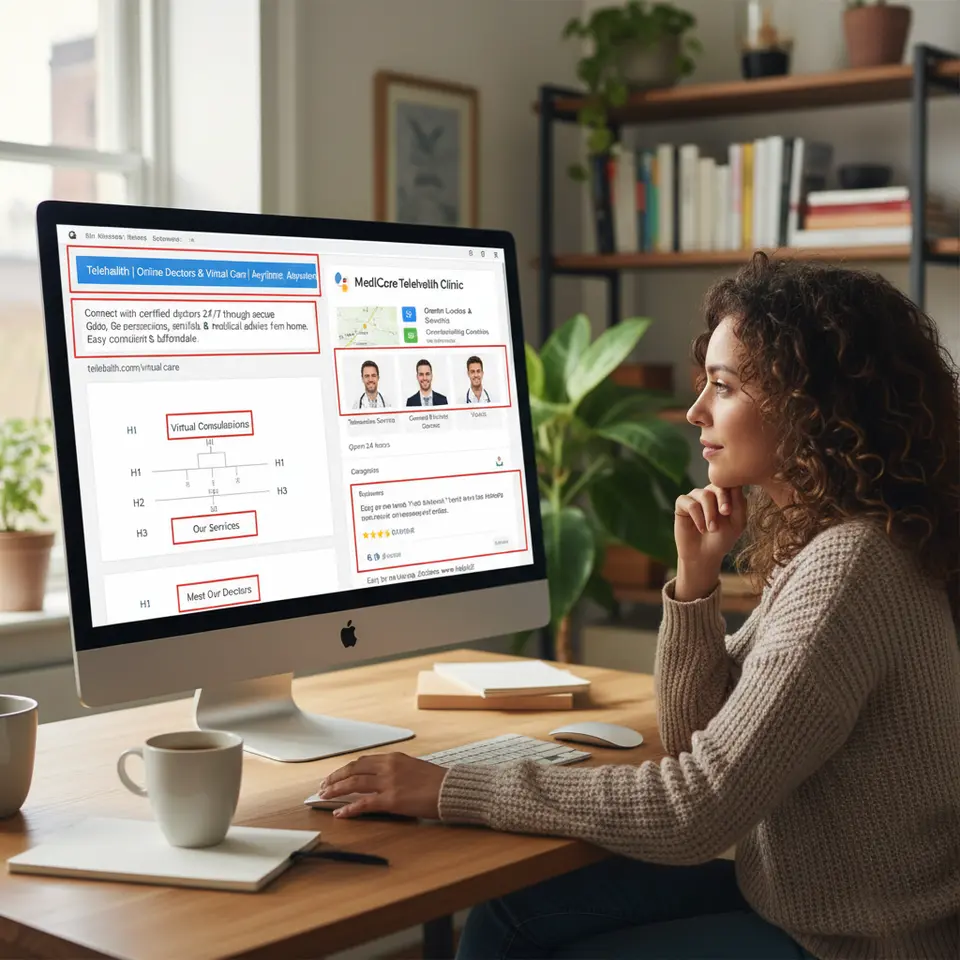
On-Page Elements
Once your keyword clusters are defined, integrate them seamlessly into your website’s on-page components. Prioritize these elements:
- Title Tags: Place primary location-based keywords at the beginning. Example: “Telehealth Psychiatry Baltimore | Virtual Mental Health Care.”
- Meta Descriptions: Craft engaging summaries that highlight service benefits and your region. Aim for 150–160 characters to avoid truncation in search results.
- Header Tags (H1–H3): Structure content with clear, descriptive headings. Include keywords where appropriate to improve both reader comprehension and SEO signals.
- URL Structure: Keep URLs concise and keyword-rich, such as yoursite.com/telehealth-pediatric-care-nyc.
- Content Depth: Address regional concerns, insurance specifics, and local regulations. Provide practical information that patients can’t easily find elsewhere to increase dwell time.
- Internal Links: Connect related pages—service pages to blog posts and vice versa—to distribute link equity and guide users through complementary content.
Google Business Profile
Even without a physical waiting room, you can claim a service-area Google Business Profile. Complete every section accurately:
- Practice Name: Use your official business name without keyword stuffing.
- Service Areas: Specify the cities or regions you serve virtually.
- Categories: Select primary and secondary categories that match your services, such as Telehealth, Medical Clinic, or Mental Health Service.
- Description: Write a concise overview with local keywords and a clear value proposition.
- Operating Hours: Highlight any after-hours or weekend availability.
- Photos: Upload professional headshots, screenshots of your telehealth platform, and branded imagery.
Encourage satisfied patients to leave reviews directly on your profile and respond to questions promptly. Frequent updates and positive feedback signal trust to both Google and prospective patients, boosting your local visibility.
Enhancing Local Authority: Citations, Backlinks, and Advanced Tactics
Building Consistent Local Citations
Local citations—mentions of your practice name, address (or registered office), and phone number (NAP)—across reputable directories strengthen your local SEO footprint. For telehealth, you can use a business address or P.O. box. Focus on healthcare-specific platforms like Healthgrades, Zocdoc, and Psychology Today, as well as regional medical association websites. Consistent NAP data prevents confusion and maximizes your authority in local search algorithms. Citation management tools, such as Moz Local or Yext, can audit your listings and ensure uniformity across hundreds of directories.
Backlink Strategies and Advanced Tactics
High-quality backlinks remain a top-ranking factor. Pursue these approaches:
- Guest Posts: Contribute expert articles to local news outlets, healthcare journals, or university-affiliated blogs, linking back to your service pages.
- Community Partnerships: Collaborate with local pharmacies, laboratories, or nonprofits on co-branded content, then exchange resource links.
- Local Media Coverage: Pitch stories about your telehealth impact to regional newspapers or radio stations, driving authoritative citations.
- Resource Guides: Create comprehensive local telehealth directories or how-to guides and share them with community organizations.
Once foundational links are in place, experiment with advanced strategies to outpace competitors. Consider geo-targeted pay-per-click campaigns that complement your organic efforts. Produce location-specific videos—virtual clinic tours or patient testimonials—and optimize metadata for local keywords. Partner with respected healthcare influencers in your region to co-create webinars or blog series, harnessing their credibility and audience reach.
Frequently Asked Questions
What is local SEO for telehealth and why is it important?
Local SEO for telehealth involves optimizing your online presence to attract patients in specific regions. It helps providers appear in local search results and map packs, reducing competition and delivering higher-intent traffic.
How can I optimize my Google Business Profile without a physical location?
Claim a service-area Google Business Profile, specify the cities or regions you serve, select relevant categories, update your description with local keywords, and encourage patient reviews to build credibility and visibility.
How often should I audit my local citations and backlinks?
Perform audits quarterly using tools like Moz Local or Yext to ensure NAP consistency and spot mismatches. Regularly review your backlink profile for quality and relevance to maintain domain authority.
Which tools can help track the performance of my local SEO efforts?
Google Analytics, Search Console, local rank tracking platforms, and citation management tools can monitor traffic, search rankings, and listing accuracy, guiding data-driven optimizations.
Conclusion
Mastering local SEO for telehealth patient acquisition is an ongoing endeavor that demands strategic planning, consistent execution, and performance monitoring. By profiling your audience, conducting targeted keyword research, and optimizing both your website and Google Business Profile, you lay the groundwork for increased visibility and patient engagement. Supplement these efforts with accurate local citations, high-quality backlinks, and advanced tactics like video SEO and influencer collaborations.
Start today with a comprehensive local SEO audit—review your on-page elements, confirm your citations, and refine your content plan. Track progress using tools such as Google Analytics, Search Console, and local rank trackers to identify opportunities for improvement. With persistence and data-driven adjustments, you’ll establish a strong virtual presence in your community, attract more qualified patients, and drive sustainable growth for your telehealth practice in this year (2026) and beyond.


I’m a telehealth marketing enthusiast dedicated to bridging the gap between healthcare and digital innovation. Through Telehealth Marketing Tips, I share practical strategies on SEO, content marketing, and patient outreach to help telemedicine brands stand out and grow. My mission is to make digital marketing simple, effective, and impactful for the healthcare industry.
















No Comments