


Finding patients virtually requires more than just offering excellent medical care; it demands precise digital visibility. Implementing targeted Local SEO Strategies for Telehealth Providers helps practices dominate regional search results. By optimizing your digital footprint, you attract highly qualified patients seeking convenient, nearby virtual healthcare solutions.
This comprehensive guide explores essential Local SEO Strategies for Telehealth Providers designed to maximize patient acquisition. We cover Google Business Profile optimization, location-specific landing pages, healthcare directory citations, and reputation management. Applying these proven techniques empowers your virtual practice to build trust, outrank local competitors, and consistently drive high-intent patient traffic to your booking platform.
The Critical Need for Local SEO Strategies for Telehealth Providers
The digital transformation of healthcare has permanently altered how patients seek medical assistance. While virtual care eliminates the need for physical travel, patient search behavior remains fundamentally localized. Prospective patients continually append geographic modifiers—such as “near me” or “in [City]”—to their search queries, even when looking specifically for virtual appointments. This behavior stems from a psychological desire to connect with physicians who understand local health dynamics and possess valid state medical licenses. Therefore, mastering Local SEO Strategies for Telehealth Providers becomes the definitive bridge connecting your virtual services with regional search intent.
Healthcare regulations mandate that physicians hold active licenses in the specific states where their patients reside during the consultation. This legislative reality completely shatters the myth that telemedicine practices can rely solely on broad, national search engine optimization. If a virtual psychiatrist licensed exclusively in California ranks nationally for “online therapy,” they waste valuable marketing resources on unqualified traffic from New York or Texas. By executing precise Local SEO Strategies for Telehealth Providers, medical professionals ensure their websites capture highly relevant, geographically qualified traffic. This targeted approach dramatically lowers patient acquisition costs while maximizing conversion rates.
Furthermore, integrating aggressive healthcare digital marketing within your local search initiatives establishes profound community trust. When patients see a virtual provider dominating their specific city’s search results, it creates an aura of localized authority. Search engines like Google actively reward this geographic relevance. They prioritize delivering hyper-local results that perfectly match the user’s IP address and search modifiers. Ultimately, deploying robust Local SEO Strategies for Telehealth Providers is no longer an optional marketing tactic; it represents the absolute foundational requirement for modern virtual clinic survival and expansion in a fiercely competitive digital landscape.
Optimizing Google Business Profile for Virtual Care Visibility
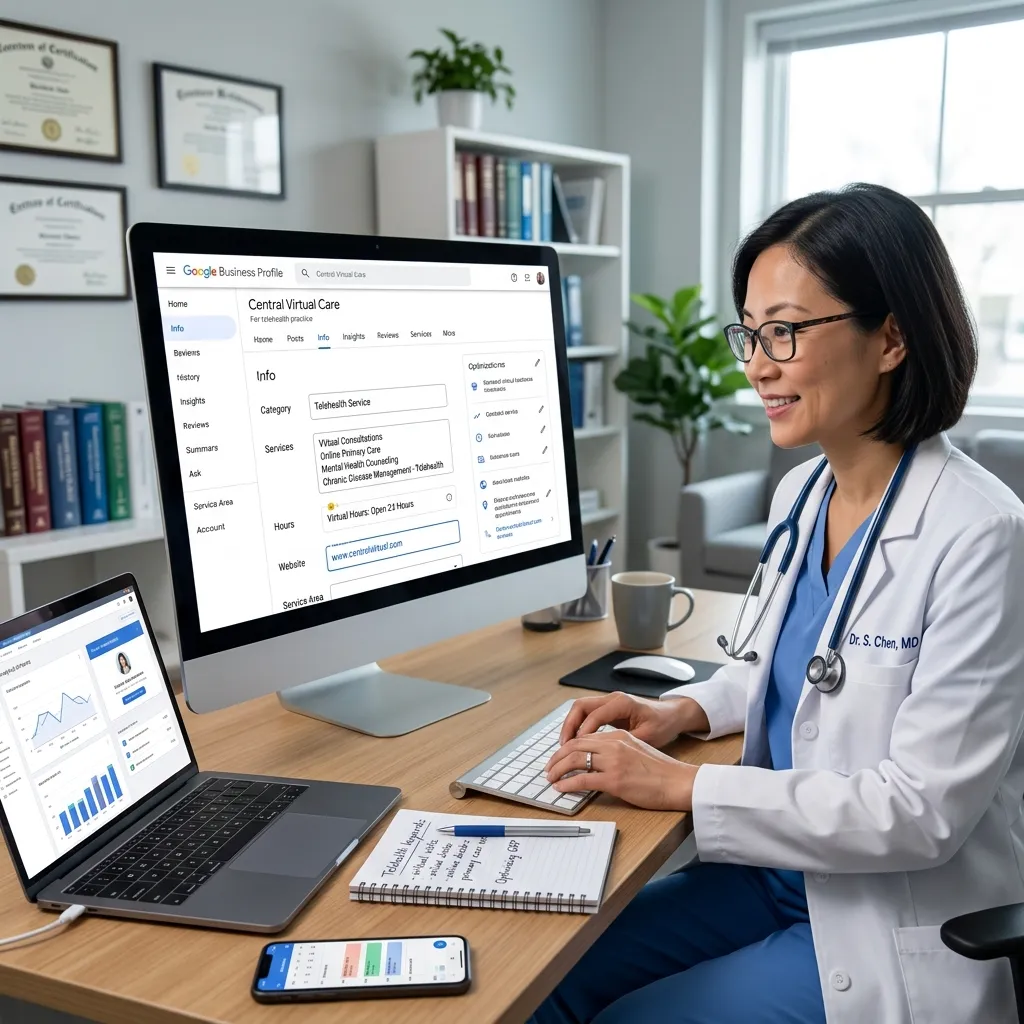
Your Google Business Profile serves as the digital front door to your practice and acts as the most influential factor in local search rankings. However, optimizing this platform for a virtual clinic presents unique challenges compared to a traditional brick-and-mortar office. When executing Local SEO Strategies for Telehealth Providers, configuring your Google Business Profile correctly ensures you appear in the highly coveted Google Local Pack without violating the platform’s strict address guidelines. Google explicitly allows telemedicine providers to maintain profiles, but you must format them as Service Area Businesses if you do not see patients at a physical location.
To establish strong virtual care search visibility, you must carefully navigate Google’s categorization and attribute settings. Selecting the most accurate primary category—such as “Telehealth Service,” “Family Practice Physician,” or your specific medical specialty—directly dictates which search queries trigger your profile. Beyond the primary category, secondary categories help capture long-tail search traffic. Most importantly, Google offers specific healthcare attributes, including “Offers online care” and “Online appointments.” Activating these attributes applies a distinct visual badge to your profile in the search results, instantly communicating your virtual capabilities to prospective patients.
-
Claim and verify your Google Business Profile, selecting the “Service Area Business” option to hide your physical home or private office address while highlighting your licensed regions.
-
Activate crucial healthcare attributes, specifically checking “Offers online care,” to ensure your profile displays the telemedicine badge in search results.
-
Consistently upload weekly updates, health tips, and clinic news using Google Posts to demonstrate active profile management and improve algorithmic engagement signals.
By meticulously updating your operating hours, linking directly to your virtual scheduling portal, and populating the Q&A section with common patient inquiries, you maximize the real estate your profile occupies on the search engine results page. Effective Local SEO Strategies for Telehealth Providers require treating your Google Business Profile not as a static directory listing, but as an active, dynamic patient engagement channel.
Developing High-Converting Location-Specific Landing Pages
Because virtual providers lack physical offices in every city they serve, capturing organic search traffic across multiple regions requires architectural ingenuity. Developing dedicated, location-specific landing pages stands as one of the most powerful Local SEO Strategies for Telehealth Providers. These geo-targeted pages allow search engine crawlers to understand exactly which cities and counties your practice serves, compensating for the absence of a localized physical address. When a patient searches for “virtual pediatrician in Austin,” a well-optimized Austin-specific landing page perfectly satisfies that exact search intent.
Creating these pages requires far more effort than simply duplicating content and swapping out the city name. Search engines actively penalize “doorway pages” that offer no unique value. To effectively leverage these pages within your Local SEO Strategies for Telehealth Providers, you must inject unique, localized context into every URL. Discuss regional health trends, mention local partnerships, outline specific state telemedicine regulations, and include hyper-local testimonials. This deep level of customization demonstrates profound localized expertise, thereby elevating your overall domain authority and ensuring you pass strict algorithm quality checks.
| SEO Element | Traditional Physical Practice | Virtual Telehealth Practice |
| Address Usage | Prominent physical address on every page | Service areas listed; physical address hidden or deemphasized |
| Page Strategy | Single “Contact Us” or “Location” page | Multiple geo-targeted landing pages for licensed regions |
| Primary CTA | “Get Directions” or “Call Office” | “Book Virtual Visit” or “Start Online Consultation” |
| Google Maps | Pinpoints exact clinic building | Highlights a broad service area polygon |
Integrating medical SEO techniques into these location pages involves optimizing meta titles, headers, and URL slugs with precise geographic modifiers. A URL structure like
/texas/austin-telehealth-services/ clearly communicates the page’s hierarchy and geographic target to search engines. By systematically building out these location pages for every major city within your licensed operating area, you cast a massive digital net, capturing high-intent patients who actively prefer local providers for their virtual healthcare needs.Leveraging Citations and Niche Healthcare Directories

Consistent online citations serve as the foundational trust signals that search engines use to verify the legitimacy of your medical practice. A citation is any online mention of your practice’s Name, Address, and Phone number (NAP). For virtual clinics implementing Local SEO Strategies for Telehealth Providers, managing citations requires a specialized approach. Since you operate as a Service Area Business, you must ensure your business name, designated service areas, dedicated practice phone number, and website URL remain perfectly consistent across the entire digital ecosystem. Inconsistencies confuse search engine crawlers, which directly degrades your local search rankings.
While general directories like Yelp and YellowPages hold value, virtual clinics must aggressively target niche healthcare directories to maximize their authority. Platforms such as Zocdoc, Healthgrades, Vitals, and WebMD carry immense domain authority in the medical space. Securing optimized profiles on these platforms represents a cornerstone of advanced Local SEO Strategies for Telehealth Providers. These medical directories frequently rank on the first page of Google for provider-specific queries. By ensuring your practice is prominently featured within them, you essentially occupy multiple spots on the search engine results page, increasing the statistical likelihood of capturing the patient’s click.
-
Conduct a comprehensive citation audit using tools like Bright Local or White spark to identify and correct any NAP inconsistencies across existing digital directories.
-
Prioritize claiming and fully optimizing profiles on top-tier medical directories, ensuring your “telehealth” or “virtual care” capabilities are explicitly stated on every platform.
-
Establish a centralized practice phone number and standardized practice name format to use uniformly across all future citation building efforts.
Furthermore, acquiring contextual backlinks from local health blogs, regional news outlets, and community organizations dramatically amplifying your local relevance. When high-authority local websites link back to your location-specific landing pages, it signals to search engines that your virtual practice is an integral part of that specific geographic community. This synergy between citation consistency and localized link building forms the bedrock of sustainable telemedicine patient acquisition.
Generating and Managing HIPAA-Compliant Patient Reviews
In the realm of healthcare, patient trust dictates practice success. Online reviews serve as the modern equivalent of word-of-mouth referrals and stand as one of the most heavily weighted algorithmic ranking factors in local search. Executing effective Local SEO Strategies for Telehealth Providers requires a proactive, systematic approach to review generation. Because virtual patients do not experience a physical waiting room or in-person staff interactions, their entire perception of your practice relies on digital touchpoints and the public feedback of previous patients. A high volume of recent, five-star reviews directly influences your click-through rate from the Google Local Pack.
However, healthcare providers face a unique and critical challenge when managing online reputation: strict privacy regulations. Every aspect of your review management strategy must incorporate flawless HIPAA-compliant marketing practices. You cannot acknowledge a patient’s medical condition, confirm their status as a patient, or reveal any protected health information (PHI) when responding to reviews. Even if a patient explicitly details their diagnosis in a public Google review, the provider’s response must remain entirely generic and professional. Mastering this delicate balance is a crucial component of advanced Local SEO Strategies for Telehealth Providers.
To ethically generate reviews, integrate automated review requests into your post-consultation workflow. Send a polite SMS or email immediately following a successful virtual visit, providing a direct link to your Google Business Profile. When responding to these reviews—which you must do to signal active engagement to search engines—use standardized, legally approved templates. A compliant response simply states, “Thank you for your feedback. We strive to provide excellent care to our community.” By prioritizing review volume and managing responses securely, you build an impenetrable wall of digital trust that attracts new patients and satisfies local search algorithms.
Technical Implementations of Local SEO Strategies for Telehealth Providers
The technical architecture of your clinic’s website dictates how efficiently search engines can crawl, index, and understand your content. Without a flawless technical foundation, even the most robust content marketing efforts will fail to achieve top rankings. For virtual practices, applying specialized Local SEO Strategies for Telehealth Providers at the code level is essential. This begins with implementing structured data, commonly known as Schema markup. By wrapping your website’s data in Medical Clinic, Physician, and Service Area schema, you provide search engines with a direct, unambiguous translation of your services, operating regions, and medical credentials.
Site speed and mobile responsiveness are absolutely critical technical ranking factors. The vast majority of patients searching for “telehealth doctors near me” execute these queries on mobile devices while experiencing immediate medical needs. If your website takes longer than three seconds to load, or if the virtual booking portal functions poorly on a smartphone, patients will immediately abandon your site for a competitor. Effective Local SEO Strategies for Telehealth Providers mandate rigorous adherence to Google’s Core Web Vitals. You must compress images, minify code, and utilize premium hosting environments to ensure lightning-fast page delivery across all geographic target areas.
Additionally, technical optimization involves establishing a logical site architecture that supports your geo-targeted content. Utilize clear, hierarchical URL structures and logical internal linking frameworks to connect your core medical services to your location-specific landing pages. When search engine bots crawl your site, they use these internal links to discover new content and distribute ranking authority throughout your domain. By meticulously refining your website’s technical health, you ensure that your Local SEO Strategies for Telehealth Providers face zero friction, allowing your practice to achieve maximum visibility and seamless patient conversions.
Common Mistakes to Avoid in Virtual Care Marketing

Many virtual practices inadvertently sabotage their own search visibility by executing flawed tactics that violate search engine guidelines. Recognizing and avoiding these pitfalls is just as critical as implementing proactive strategies. When developing Local SEO Strategies for Telehealth Providers, the most damaging mistake involves setting up a virtual office or P.O. Box as a physical practice location on Google Business Profile. Google’s algorithms actively hunt for and suspend profiles using fake physical addresses. Always adhere strictly to the Service Area Business guidelines to protect your digital presence from catastrophic penalties.
Another frequent error involves keyword cannibalization across location pages. If you create twenty different city pages but fail to differentiate the content on those pages, search engines will view them as duplicate content. Instead of ranking for all twenty cities, the algorithm will become confused, and your domain authority will plummet. Successful Local SEO Strategies for Telehealth Providers require investing the time to write highly unique, localized copy for every single geographic target addiction treatment patient.
Finally, providers often neglect the importance of maintaining an active presence after the initial optimization phase. Local SEO is not a “set it and forget it” endeavor. Failing to consistently publish new localized content, ignoring incoming patient reviews, or letting your directory citations become outdated will result in a rapid decline in search rankings. You must treat your local digital footprint as a living ecosystem that requires continuous maintenance, testing, and refinement to stay ahead of regional competitors.
Expert Insights and Advanced Pro Tips
To truly dominate the search engine results pages and outpace aggressive competitors, virtual clinics must adopt advanced tactics that push beyond standard optimization. The most successful implementations of Local SEO Strategies for Telehealth Providers leverage the concept of E-E-A-T: Experience, Expertise, Authoritativeness, and Trustworthiness. Search engines heavily scrutinize medical websites, applying strict “Your Money or Your Life” (YMYL) algorithmic filters. To satisfy these filters, ensure every piece of medical content on your site is written or medically reviewed by a credentialed physician, featuring comprehensive author bios linking to their verified medical licenses.
-
Hyper-Local Content Marketing: Do not just build location pages; create blog content that addresses specific seasonal health issues prevalent in your target cities (e.g., “Managing Cedar Fever Allergies in Austin”).
-
Video SEO Integration: Embed short, professionally recorded introductory videos of your physicians onto your location pages and optimize the video titles with local keywords to increase dwell time and engagement.
-
Local PR and Link Building: Sponsor local health fairs, community sports teams, or regional non-profits to earn highly authoritative, hyper-local backlinks from
.organd.edudomains within your target service areas.
By synergizing these advanced techniques with your foundational Local SEO Strategies for Telehealth Providers, you create an insurmountable competitive advantage. You transition from merely trying to rank for keywords to establishing your practice as the undisputed, authoritative voice for virtual healthcare within your designated geographic regions. This holistic approach guarantees long-term visibility, unshakeable patient trust, and sustainable practice growth.
Conclusion
Mastering effective Local SEO Strategies for Telehealth Providers ensures your practice reaches the right patients at the exact moment they need care. Start optimizing your digital presence today to build trust, enhance your regional authority, and increase daily bookings. Take action now, implement these proven tactics, and transform your virtual clinic into a top-ranking, highly profitable healthcare destination.
FAQs
1. How do Local SEO Strategies for Telehealth Providers differ from traditional medical SEO?
Traditional medical SEO heavily emphasizes a physical clinic’s address and driving directions. Telehealth local SEO focuses on optimizing for Service Area Businesses (SABs) in Google Business Profile, creating geo-targeted landing pages for licensed states or cities, and building local relevance without relying on a physical patient-facing office.
2. Can I use a Google Business Profile if I only offer virtual appointments?
Yes, Google specifically permits telehealth providers to create and manage profiles. However, you must set your profile up as a Service Area Business, hiding your home or administrative address, and define the specific cities or zip codes where you are licensed to provide virtual care.
3. Why do patients search for “near me” when looking for online doctors?
Patients use geographic modifiers for virtual care because they want a doctor who understands local health trends, is guaranteed to be licensed in their state, and operates within their specific time zone. It also provides a psychological sense of trust and community connection.
4. What is the most important ranking factor for telehealth local SEO?
Consistent NAP (Name, Address, Phone number) citations across directories, an accurately configured Google Business Profile with telehealth attributes selected, and a high volume of positive, recent patient reviews are the most critical ranking factors for local virtual visibility.
5. How can I safely respond to patient reviews without violating HIPAA?
Never confirm the person is a patient, mention their specific treatment, or discuss their medical history. Keep responses brief, professional, and generic. For example: “Thank you for your feedback. We are dedicated to providing accessible care to everyone in our community.”
6. Do I need a separate location page for every city I serve?
While you don’t need a page for every single tiny town, you should create dedicated, uniquely written location pages for the major metropolitan areas or counties where you actively want to acquire patients and hold valid medical licenses.
7. What is Schema markup, and why do virtual clinics need it?
Schema markup is specialized code added to your website that helps search engines understand your content perfectly. Telehealth providers should use MedicalClinic, Physician, and ServiceArea schema to explicitly communicate their virtual capabilities and geographic operating zones to Google’s bots.
8. Will a P.O. Box help me rank in a specific city for telehealth?
No. Using a P.O. Box or a virtual office address to trick Google into thinking you have a physical clinic is a direct violation of Google Business Profile guidelines. Doing so will almost certainly result in your profile being suspended and removed from search results.
9. How quickly can I expect to see results from telehealth local SEO?
Local SEO is a long-term strategy. While optimizing your Google Business Profile might yield minor visibility improvements in a few weeks, establishing strong domain authority, building citations, and ranking competitive location pages typically takes 3 to 6 months of consistent effort.
10. Can I rank nationally and locally at the same time?
Yes, but it requires a dual strategy. Your Local SEO Strategies for Telehealth Providers will capture regional intent via location pages and Google Maps, while your broader content marketing and blog strategy can target national, informational queries related to your medical specialty.
Telehealth seo, Medical marketing, Patient acquisition, Healthcare seo, Virtual care


I’m a digital marketing expert passionate about transforming how telehealth brands connect with patients online. At Telehealth Marketing Tips, I write about the intersection of healthcare and digital strategy — from SEO and social media to patient engagement and brand growth. My goal is to help telehealth professionals thrive in the digital age with smart, data-driven marketing insights.
















No Comments