


In today’s digital landscape, telehealth services have become a cornerstone of modern healthcare delivery. As virtual visits and remote consultations surge in popularity, healthcare organizations must ensure that every marketing dollar drives measurable results.
Understanding telehealth marketing ROI empowers providers to allocate resources wisely, refine patient acquisition strategies, and demonstrate tangible value to stakeholders. Without a clear framework for measurement, even substantial budgets risk producing marginal returns, leaving practices unable to scale effectively.
This year, the competition for patient attention is fiercer than ever, and marketers need robust metrics to guide decision-making. By establishing a comprehensive system for tracking telehealth marketing ROI, organizations can uncover which channels deliver high-value patients, optimize messaging for improved engagement, and ultimately boost long-term profitability. In this article, we explore fundamental concepts, essential metrics, cutting-edge tools, and actionable strategies designed to help you measure and maximize telehealth marketing ROI in a rapidly evolving industry.
Why Measuring Telehealth Marketing ROI Matters in Today’s Digital Healthcare Environment

Telehealth marketing ROI isn’t just a financial calculation; it’s a strategic compass that navigates the complexity of patient acquisition, engagement, and retention. As virtual care continues to integrate with traditional services, healthcare marketers encounter unique challenges: multi-step patient journeys, stringent privacy regulations, and fluctuating digital touchpoints. By systematically measuring return on investment, teams can pinpoint high-performance campaigns, refine resource allocation, and justify marketing spend to executives and board members.
Healthcare organizations often invest in a mixture of search engine marketing, social media promotion, content development, and email automation. While each tactic holds promise, marketing budgets remain finite. Calculating telehealth marketing ROI brings clarity to which initiatives yield the highest patient lifetime value compared to cost. This precision enables marketers to:
- Reallocate funds from underperforming channels into campaigns with proven success
- Identify and nurture high-value patient segments based on acquisition source
- Optimize creative assets and messaging to resonate with target audiences
- Demonstrate concrete results in quarterly or annual performance reviews
By embedding ROI measurement into your routine reporting, you foster a culture of data-driven decision-making. This approach reduces wasteful spending, promotes continuous improvement, and positions your telehealth program for sustainable growth in a competitive market.
Key Metrics Driving Telehealth Marketing ROI Evaluation
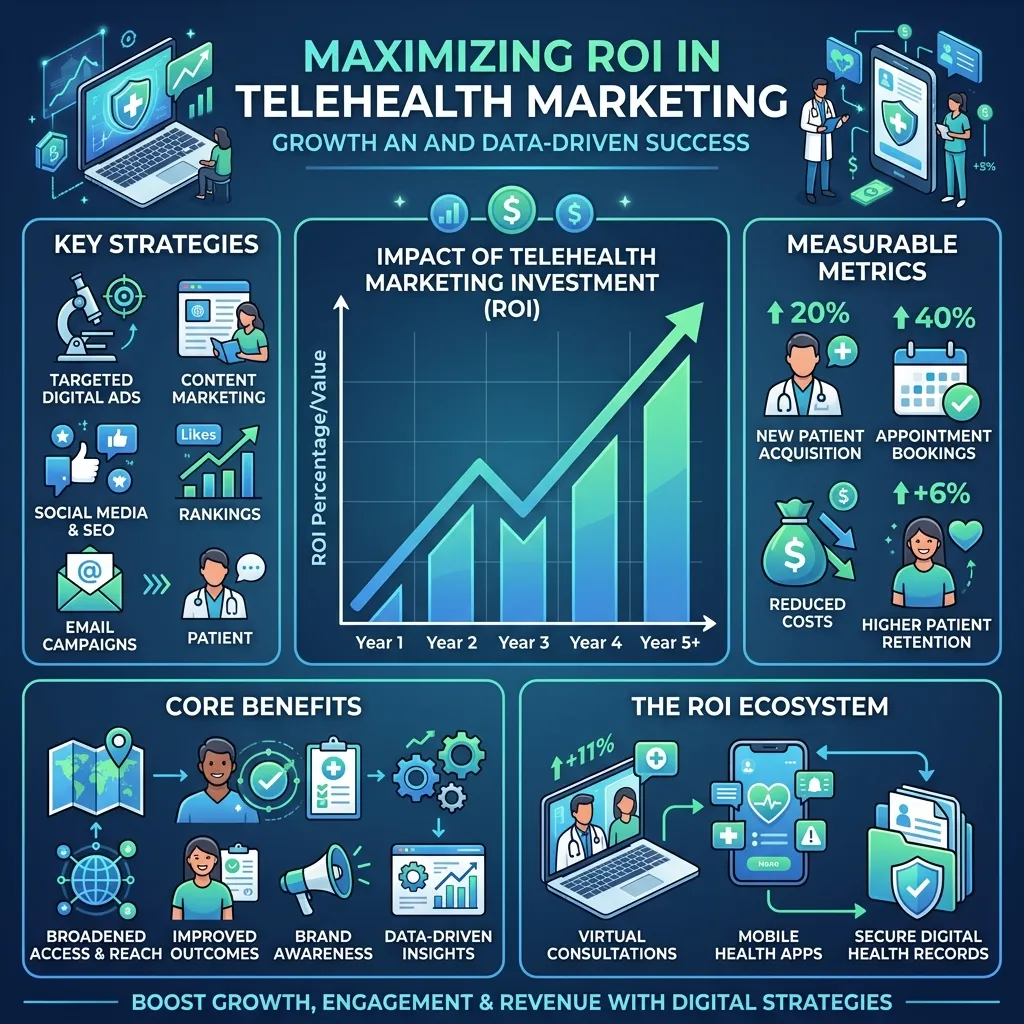
Solid telehealth marketing ROI calculations rest on a core set of metrics that quantify cost, revenue, and patient behavior over time. Below are the primary indicators you should track:
Customer Acquisition Cost (CAC)
CAC represents the average spend required to bring a new telehealth patient on board. It is calculated by dividing total marketing expenses (ad spend, content production, software fees) by the number of new patients acquired in the same period. A lower CAC indicates efficient campaign performance. To reduce CAC, consider refining audience targeting in platforms like Google Ads or Facebook, improving landing page design, and leveraging organic channels to supplement paid efforts.
Patient Lifetime Value (LTV)
LTV forecasts the total revenue generated by a single patient throughout their engagement with your telehealth service. For virtual care, this includes initial consultation fees, follow-up appointments, ancillary services (e.g., lab tests), and potential referrals. Use the formula:
LTV = Average Visit Value × Average Annual Visits × Patient Lifespan (years)
Comparing LTV to CAC reveals whether acquisition investments yield profitable relationships over time. An LTV:CAC ratio above 3:1 is commonly cited as a healthy benchmark.
Conversion Rates Across Channels
Understanding how different marketing channels drive booked appointments is essential. Measure conversion rate by dividing the number of completed telehealth bookings by the total clicks or impressions per channel, then multiply by 100. Monitoring channel-specific conversion rates—search ads, social media, email, and organic traffic—helps you shift budgets toward high-performing sources and refine underperforming channels through A/B testing.
Engagement and Retention Indicators
Engagement metrics such as click-through rates (CTR), time on page, and video completion rates provide insight into content resonance. Meanwhile, retention metrics like churn rate (patients who don’t return) and repeat booking percentages directly impact revenue sustainability. Reducing churn via patient satisfaction surveys, personalized follow-up emails, and loyalty initiatives enhances overall telehealth marketing ROI by increasing recurring visits.
Essential Tools and Platforms to Track Telehealth Marketing ROI
Accurate measurement of telehealth marketing ROI requires a robust tech stack that consolidates data from multiple sources. Below are the indispensable tools you should integrate:
Google Analytics and Google Tag Manager

Google Analytics offers deep insights into website traffic, user pathways, and conversion funnels. By implementing Google Tag Manager with custom events and UTM parameters, you can attribute telehealth booking form submissions to specific campaigns, keywords, or creative variants. This granular data is critical for calculating CAC and conversion rates.
Telehealth Platform Dashboards
Major telehealth platforms provide built-in analytics covering appointment volumes, patient demographics, and session durations. Export this data or connect via APIs to your CRM and analytics suite to evaluate how marketing campaigns translate into actual virtual visits. Consolidating platform metrics with external tracking ensures a holistic view of telehealth marketing ROI.
CRM and Marketing Automation Solutions
Systems like HubSpot, Salesforce Health Cloud, or Microsoft Dynamics 365 enable lead scoring, email segmentation, and automated nurturing workflows. By tagging leads based on source and campaign, you can trace patient journeys from initial contact through booking and beyond. This end-to-end visibility makes it easier to assign revenue credit and compute precise ROI figures.
Call Tracking and Chat Analytics
Offline interactions such as phone calls and website chat sessions often result in telehealth bookings. Deploy call-tracking numbers and chat analytics tools to capture call duration, outcomes, and source references. Linking these insights to digital campaigns ensures you’re not overlooking valuable conversions that occur off the web.
Attribution Models for Accurate ROI Insights

Attribution determines how credit for conversions is distributed across marketing touchpoints. Selecting the right model is essential for authentic telehealth marketing ROI analysis. Common frameworks include:
First-Touch Attribution
This model assigns full credit to the initial interaction a patient has with your brand. While simple, it may understate the impact of follow-up campaigns.
Last-Touch Attribution
Conversely, last-touch gives all credit to the final touchpoint before booking. Though popular, it can overlook the role of earlier awareness and consideration efforts.
Linear Attribution
Linear distribution splits credit equally across every touchpoint in the patient journey. This balanced approach acknowledges all interactions but may dilute focus on high-impact channels.
Time-Decay Attribution
Time-decay awards progressively higher credit to touchpoints closer to the conversion event. This model recognizes the cumulative influence of campaigns while emphasizing recent interactions.
For complex telehealth journeys, multi-touch attribution platforms or custom weighting strategies often yield the most accurate ROI picture. Align your model with data availability and the intricacy of your marketing mix to ensure fair credit assignment.
Optimizing Telehealth Marketing ROI for Sustainable Growth
Once baseline ROI metrics are established, continuous optimization is the key to long-term success. Implement these best practices to enhance telehealth marketing ROI:
Budget Reallocation and A/B Testing
Regularly review channel performance and shift spend toward campaigns with the lowest CAC and highest LTV. Simultaneously, conduct A/B tests on ad copy, landing page layouts, and email subject lines to identify winning combinations that boost conversion rates.
Personalization and Patient Segmentation
Group prospects by demographics, health conditions, or past engagement behavior. Tailor messaging and offers to each segment—such as targeted follow-up reminders for chronic care patients—to increase relevance and conversion likelihood.
Improving User Experience
Enhance website and mobile app speed, simplify appointment booking forms, and ensure clear calls to action. A seamless user journey reduces drop-off and elevates completion rates, directly improving telehealth marketing ROI.
Retargeting and Loyalty Programs
Leverage retargeting ads and email workflows to re-engage visitors who initiated but did not complete a booking. Offer loyalty incentives—like discounted follow-up visits or referral credits—to boost retention and elevate patient lifetime value.
By combining strategic budget shifts, rigorous testing, and hyper-personalized outreach, your organization can consistently enhance telehealth marketing ROI, ensuring every campaign fuels sustainable growth.
Conclusion
Measuring telehealth marketing ROI is an ongoing discipline that blends quantitative rigor with strategic agility. By tracking key metrics—CAC, LTV, channel conversions, engagement, and retention—and leveraging authoritative tools such as Google Analytics, CRM platforms, and call-tracking systems, healthcare marketers can illuminate which campaigns drive genuine patient outcomes. Choosing the right attribution model further refines your ROI calculations, enabling fair credit distribution across touchpoints.
In today’s competitive environment, continuous optimization through A/B testing, personalization, and UX improvements guarantees that your telehealth marketing investments deliver sustainable value. For further guidance on patient engagement strategies, explore resources from the CDC and the National Institutes of Health. Embrace data-driven decision-making today and transform insights into actionable strategies that maximize telehealth marketing ROI this year.
FAQ
What is telehealth marketing ROI, and why is it important?
Telehealth marketing ROI measures the return on investment from marketing activities aimed at acquiring and retaining telehealth patients. It’s crucial because it helps organizations identify high-performing channels, optimize spending, and justify budgets with concrete financial data.
How do I calculate Customer Acquisition Cost (CAC) for telehealth?
CAC is calculated by dividing total marketing expenses (including ad spend, content production, and software fees) by the number of new patients acquired in the same period. Reducing CAC involves refining targeting, improving creatives, and leveraging organic channels.
Which attribution model should telehealth marketers use?
The choice depends on your campaign complexity and data availability. Simple programs might start with first-touch or last-touch attribution, while advanced teams benefit from linear or time-decay models, or even custom multi-touch strategies that fairly distribute credit across touchpoints.
How can I reduce patient churn and improve retention?
Enhance patient experience with personalized follow-up, satisfaction surveys, loyalty incentives, and streamlined booking processes. Consistent engagement and value-driven communications help turn one-time visitors into long-term patients.
What is telehealth marketing ROI?
Telehealth marketing ROI refers to the return on investment generated from marketing campaigns designed to attract and retain telehealth patients. It measures how effectively your marketing efforts convert spending into revenue, patient appointments, and long-term growth.
Why is measuring telehealth marketing ROI important?
Measuring telehealth marketing ROI helps healthcare providers understand which marketing channels deliver the best results. It supports smarter budget allocation, improves campaign performance, and increases patient acquisition efficiency.
How do you calculate telehealth marketing ROI?
Telehealth marketing ROI is commonly calculated using the formula:
ROI = (Revenue Generated – Marketing Costs) ÷ Marketing Costs × 100
This calculation helps determine whether marketing campaigns are profitable.
What is Customer Acquisition Cost (CAC) in telehealth marketing?
Customer Acquisition Cost (CAC) measures how much a healthcare organization spends to acquire a new telehealth patient. It includes advertising costs, software expenses, content creation, and marketing campaign spending.
What is a good LTV to CAC ratio for telehealth marketing?
A healthy LTV to CAC ratio for telehealth marketing is generally considered to be 3:1 or higher. This means the patient lifetime value significantly exceeds the cost of acquiring that patient.
Which marketing channels work best for telehealth services?
Effective telehealth marketing channels often include:
- Google Ads
- Search engine optimization (SEO)
- Social media marketing
- Email marketing
- Content marketing
- Retargeting campaigns
- Video marketing
The best-performing channels depend on your audience and healthcare niche.
How can telehealth providers improve marketing ROI?
Telehealth providers can improve marketing ROI by:
- Optimizing landing pages
- Improving targeting strategies
- Using A/B testing
- Personalizing campaigns
- Reducing patient acquisition costs
- Enhancing user experience
- Increasing patient retention rates
What tools help track telehealth marketing ROI?
Popular tools for tracking telehealth marketing ROI include:
- Google Analytics
- Google Tag Manager
- HubSpot
- Salesforce Health Cloud
- Hotjar
- CallRail
- Microsoft Dynamics 365
These platforms help measure traffic, conversions, engagement, and patient acquisition performance.
What attribution model is best for telehealth marketing?
The best attribution model depends on campaign complexity. Many telehealth organizations use:
- First-touch attribution
- Last-touch attribution
- Linear attribution
- Time-decay attribution
- Multi-touch attribution
Multi-touch attribution often provides the most accurate understanding of patient journeys.
How does SEO improve telehealth marketing ROI?
SEO improves telehealth marketing ROI by increasing organic website traffic, lowering paid advertising dependence, and attracting highly targeted patients searching for virtual healthcare services online.
Why is patient retention important for telehealth ROI?
Patient retention increases lifetime value and reduces the need for constant new patient acquisition. Returning patients generate recurring revenue and improve long-term telehealth profitability.
How can telehealth providers reduce patient churn?
Healthcare organizations can reduce patient churn by:
- Offering personalized follow-up care
- Sending appointment reminders
- Improving virtual care experiences
- Providing loyalty incentives
- Maintaining consistent communication
What metrics should telehealth marketers monitor regularly?
Important telehealth marketing metrics include:
- Customer Acquisition Cost (CAC)
- Patient Lifetime Value (LTV)
- Conversion rates
- Click-through rates (CTR)
- Bounce rates
- Retention rates
- Return on investment (ROI)
How does landing page optimization affect telehealth marketing ROI?
An optimized telehealth landing page improves conversion rates, reduces bounce rates, and increases appointment bookings, which directly enhances overall marketing ROI.
Can small healthcare practices benefit from telehealth marketing ROI tracking?
Yes, even small healthcare practices benefit from ROI tracking because it helps maximize limited budgets, identify profitable marketing channels, and improve patient acquisition strategies efficiently.


I’m a telehealth marketing enthusiast dedicated to bridging the gap between healthcare and digital innovation. Through Telehealth Marketing Tips, I share practical strategies on SEO, content marketing, and patient outreach to help telemedicine brands stand out and grow. My mission is to make digital marketing simple, effective, and impactful for the healthcare industry.
















No Comments